Cybersecurity
Threat Detection
Managed Security Services
Dealing with a security breach or ransomware attack? Get help and recover now!
Get help and recover now!

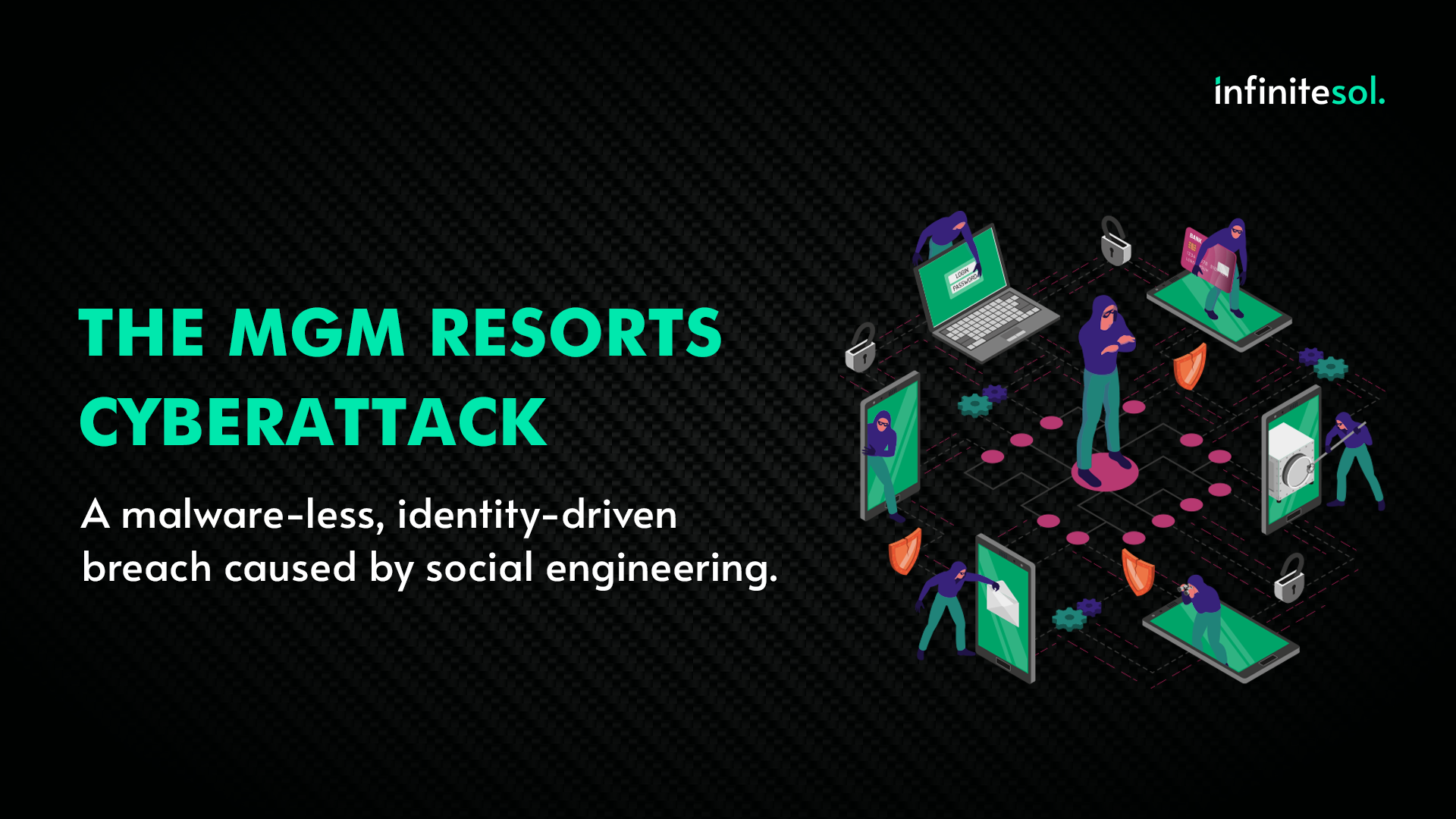
The MGM Breach Didn’t Break In — It Logged In

Category
Cybersecurity
Threat Detection
Managed Security Services

The Shift in How Breaches Happen

Modern cyberattacks rarely resemble traditional break-ins. There are no alarms triggered by shattered defenses or obvious signs of forced entry. Instead, many of today’s most damaging incidents begin quietly, inside trusted systems, through routine decisions that were never intended to be adversarial.

This shift has redefined how breaches occur, moving the attack surface away from infrastructure and toward identity, process, and human workflows.

One of the clearest examples of this evolution is the 2023 cyber incident involving MGM Resorts International. The breach demonstrated how operational trust and everyday access decisions can create an attack path even in organizations with mature security programs. Rather than exploiting a technical vulnerability, the attackers leveraged the way systems and people were designed to work together.

Where the Breach Actually Started

In September 2023, MGM Resorts experienced a cyber incident that disrupted operations across multiple hotel and casino properties in the United States.

Guests encountered issues with hotel check-ins. Digital room keys stopped functioning. Casino systems were affected, and internal corporate platforms were taken offline.

For a business that depends heavily on availability and customer experience, the impact was immediate and highly visible.

What made the MGM incident especially significant was not the scale of the disruption, but how the attack began. There was no reported zero-day vulnerability, no sophisticated malware deployed against perimeter defenses, and no traditional network breach. Instead, attackers reportedly gained initial access through social engineering directed at the IT help desk.

By impersonating an employee and using urgency combined with contextual information, the attackers convinced support staff to reset authentication controls, including multi-factor authentication. That single action provided them with legitimate access to internal systems. At that point, no technical defenses needed to be bypassed. The attackers were operating entirely within the environment using credentials that systems were designed to trust.

Once access was established, identity systems became the pivot point. From there, attackers were able to move laterally across interconnected environments that relied on identity-based trust. While the estimated financial impact reached hundreds of millions of dollars, the more important outcome was structural. The incident exposed how deeply trust assumptions are embedded in everyday operational workflows.

Why Existing Security Controls Didn’t Matter

The breach followed the rules the systems were built on.

At first glance, the MGM breach may appear to be a failure of technology. In reality, it was not caused by missing firewalls, weak endpoint protection, or a lack of network segmentation. Those controls existed and functioned as intended. The failure occurred at the intersection of identity, process, and human decision-making.

Help desk workflows are designed for speed and availability. Their primary goal is to restore access quickly so business operations can continue. In identity-centric environments, however, a single support decision can effectively redefine the security perimeter. Resetting authentication controls transformed what appeared to be a routine operational task into a high-impact security event. The systems involved behaved exactly as designed. The issue was not misconfiguration, but misplaced trust.

This distinction is critical to understanding why similar incidents continue to occur despite investments in advanced security tooling.

How Modern Attacks Really Work

The MGM incident reflects a broader pattern now seen across industries. Modern attackers increasingly avoid technical exploitation and instead focus on blending into legitimate workflows. They target areas where identity decisions are made quickly, ownership is unclear, or visibility is limited.

These environments often include help desks, internal tools, temporary access grants, legacy systems, and transitional platforms that remain connected long after their original purpose has changed. Over time, trust accumulates quietly while scrutiny fades. When attackers enter through these paths, security tools may not detect them as anomalies because, from a technical perspective, nothing unusual is happening.

Why This Should Concern Every Organization

The most important lesson from the MGM breach is not about one company or one incident. It is about how modern organizations define risk. Security failures today are frequently rooted in deferred decisions rather than missing controls. Temporary access becomes permanent, exceptions are never revisited, ownership changes, and permissions remain.

As environments become more interconnected, identity decisions increasingly define the true blast radius of an incident. The question is no longer whether strong security tools are in place, but whether the trust assumptions embedded in everyday processes are still valid.

What This Incident Ultimately Reveals

The MGM Resorts incident serves as a clear example of how modern breaches succeed. Attackers did not break down defenses; they navigated trust. For organizations looking to reduce risk, the lesson is not simply to deploy more tools, but to closely examine where identity, access, and human workflows intersect especially in places that feel routine, safe, or operationally necessary.

In modern environments, the most dangerous attack paths often look exactly like normal business processes.

Newsletter
This is some text inside of a div block.
Thank you! Your submission has been received!
Oops! Something went wrong while submitting the form.