Cybersecurity
Emerging Technologies
Dealing with a security breach or ransomware attack? Get help and recover now!
Get help and recover now!

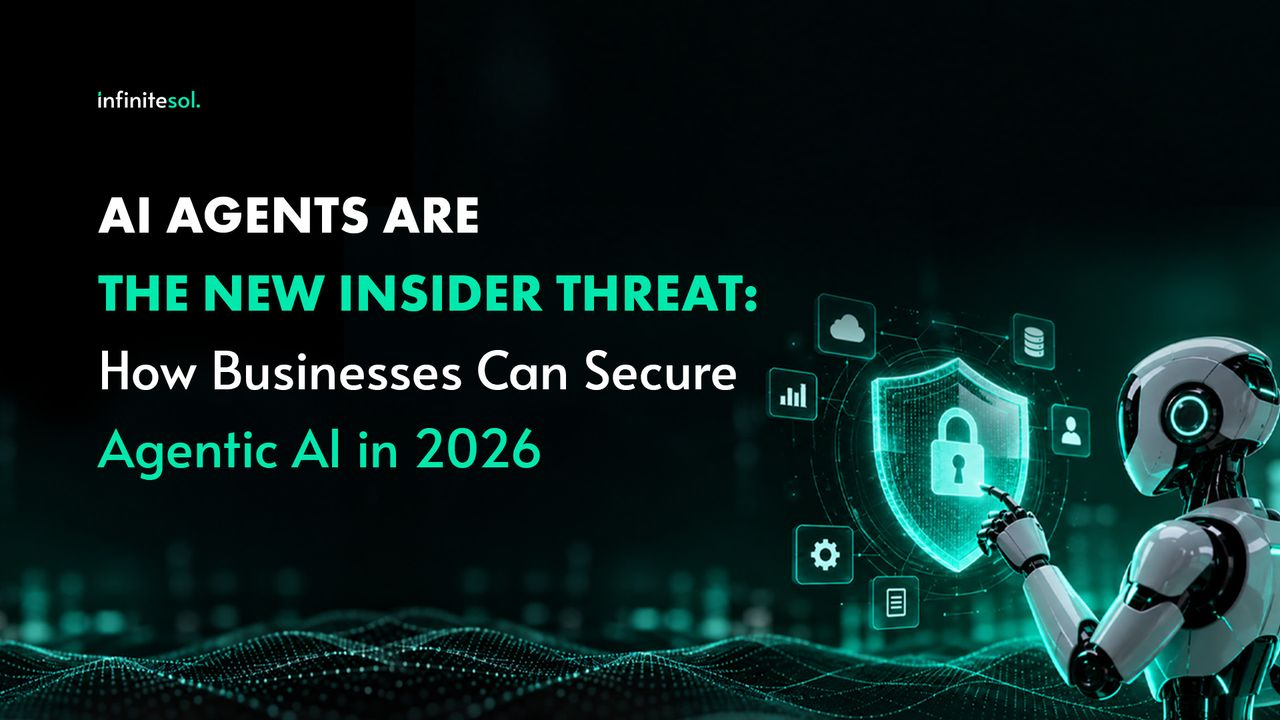
AI Agents Are the New Insider Threat: How Businesses Can Secure Agentic AI

Category
Cybersecurity
Emerging Technologies

Artificial intelligence is moving beyond chatbots.

Businesses are now deploying AI agents that can read emails, access cloud environments, analyze company data, interact with applications, execute workflows, write code, and make decisions with limited human involvement.

That level of automation can dramatically improve productivity.

But it also creates a new cybersecurity challenge.

An AI agent with access to sensitive systems can become another privileged identity inside your organization. If that agent is misconfigured, manipulated, compromised, or granted excessive permissions, an attacker may be able to use it to access sensitive information or perform unauthorized actions.

As organizations accelerate AI adoption, securing these non-human identities is quickly becoming a major cybersecurity priority.

What Is an AI Agent?

Traditional generative AI tools generally wait for a user to provide a prompt and then generate a response.

AI agents can go several steps further.

Depending on how they are configured, an agent may be able to:

  • Access business applications
  • Connect to APIs
  • Search internal documents
  • Read and send emails
  • Access cloud resources
  • Write or execute code
  • Create or modify files
  • Query databases
  • Interact with other AI agents
  • Perform multi-step workflows automatically

This ability to take action is what makes agentic AI powerful.

It is also what increases the security risk.

An AI assistant that simply summarizes a document has limited impact.

An AI agent that can access your Microsoft 365 environment, cloud infrastructure, customer database, or production systems has a considerably larger attack surface.

Why AI Agents Are Becoming a Cybersecurity Concern

Microsoft's 2026 Digital Defense Report describes a cybersecurity environment in which AI is changing the speed, scale, economics, and autonomy of cyberattacks. Threat actors are increasingly using AI for reconnaissance, phishing, vulnerability discovery, malware development, data analysis, and post-compromise activity.

At the same time, businesses are introducing AI agents into sensitive workflows.

That creates an important security question:

What happens when an AI system is given access to the same resources as an employee?

The answer is that organizations must begin treating AI agents as identities that require governance, monitoring, and access controls.

Microsoft recently described AI agents as a potential new form of insider risk because agents may have access to corporate data, applications, tools, and other systems while operating at machine speed.

The risk does not necessarily come from the AI agent intentionally behaving maliciously.

Instead, an agent can:

  • Make an incorrect decision
  • Be manipulated through malicious content
  • Use excessive permissions
  • Expose confidential information
  • Interact with an unauthorized tool
  • Execute an unintended action
  • Become compromised through another system

This means organizations need security controls that assume an AI agent can fail or become compromised.

The Biggest AI Agent Security Risks Businesses Should Watch

1. Excessive Permissions

One of the most significant risks is giving an AI agent more access than it actually needs.

For example, an agent designed to analyze monthly financial reports may only need read access to a specific folder.

Giving that same agent broad access to the company's entire cloud storage environment dramatically increases the potential impact of a compromise.

The traditional cybersecurity principle of least privilege becomes even more important with autonomous systems.

AI agents should receive only the permissions required to complete a specific task.

Whenever possible, those permissions should also be temporary.

2. Prompt Injection Attacks

Prompt injection has become one of the most discussed security risks surrounding generative AI.

A prompt injection attack occurs when malicious instructions are inserted into content that an AI system processes.

Imagine an AI agent automatically reviewing documents submitted through a website.

An attacker could potentially place hidden instructions inside a document attempting to convince the agent to ignore its original instructions or perform an unauthorized action.

The danger increases when the AI system can interact with external tools or sensitive business systems.

Prompt injection therefore needs to be treated as more than an AI quality problem.

It can become an access-control and cybersecurity problem.

3. Sensitive Data Exposure

AI agents often require data to operate effectively.

That data could include:

  • Customer records
  • Employee information
  • Financial documents
  • Internal emails
  • Source code
  • Authentication information
  • Intellectual property
  • Confidential business documents

Without proper controls, sensitive information may be exposed to unauthorized services, stored incorrectly, or included in AI-generated responses.

Organizations adopting AI should understand exactly what information each agent can access, where that information goes, and whether it can leave the approved environment.

4. AI Agent Identity Theft

Businesses have spent years strengthening employee identity security.

Now another identity category is emerging: machine and AI identities.

Every AI agent should have its own identity rather than simply inheriting the full permissions of the employee using it.

This allows security teams to answer critical questions such as:

  • Which AI agent accessed the system?
  • Who owns that agent?
  • What permissions does it have?
  • What information did it access?
  • What actions did it perform?
  • When was its access granted?
  • Can its access immediately be revoked?

Without clear identity management, organizations can lose visibility into actions performed by autonomous systems.

5. Compromised APIs and AI Integrations

AI platforms rarely operate independently.

They often connect to:

  • SaaS applications
  • Cloud platforms
  • Databases
  • APIs
  • Developer tools
  • Model Context Protocol servers
  • Internal applications
  • Third-party services

Every integration adds another potential path into the organization.

A vulnerable plugin, compromised API credential, poorly secured service account, or malicious third-party integration can become an entry point for attackers.

AI security therefore cannot focus only on the model.

Organizations must secure the entire ecosystem surrounding it.

6. Shadow AI and Agent Sprawl

Employees can now create AI-powered workflows faster than many IT departments can discover them.

This can create Shadow AI, similar to the Shadow IT problem organizations have faced for years.

Different departments may deploy AI assistants, automation platforms, browser agents, coding agents, and SaaS AI applications without centralized security oversight.

Eventually, security teams may not know:

  • Which agents exist
  • Who created them
  • What information they access
  • Which applications they connect to
  • What credentials they use

You cannot secure what you cannot see.

Maintaining an inventory of approved AI systems and agents should therefore become part of modern cybersecurity governance.

How Businesses Can Secure AI Agents

Protecting AI systems does not require abandoning the cybersecurity principles organizations already use.

Instead, those principles need to be extended to AI.

Give Every AI Agent a Separate Identity

AI agents should not automatically operate with all the privileges of the person deploying them.

Each agent should have a clearly identifiable account or machine identity with controlled permissions.

This improves accountability and makes suspicious behavior easier to investigate.

Apply Zero Trust Principles

Zero Trust follows a simple idea:

Never trust automatically. Always verify.

The same philosophy should apply to AI agents.

Every request for access should be evaluated based on factors such as:

  • Identity
  • Permissions
  • Device or workload
  • Requested resource
  • Risk level
  • Business context

An AI agent should never receive unlimited access simply because it operates inside the corporate environment.

Use Least-Privilege Access

Give AI agents only the minimum permissions required for their function.

If an agent needs to read a report, it should not automatically receive permission to delete, modify, or distribute that report.

For high-risk operations, organizations should consider requiring human approval.

Monitor AI Agent Activity

Traditional endpoint monitoring may not provide enough visibility into autonomous AI activity.

Security teams should monitor:

  • Authentication attempts
  • API calls
  • Cloud activity
  • Data access
  • Permission changes
  • Unusual downloads
  • Abnormal application behavior
  • Unexpected network connections

Continuous monitoring becomes increasingly important because AI agents can execute actions much faster than human users.

Protect Credentials and API Keys

AI systems commonly rely on service accounts, tokens, API keys, and cloud credentials.

These credentials should never be hard-coded into scripts or stored in insecure locations.

Businesses should use centralized secrets management, credential rotation, strong authentication, and access logging.

Continuously Assess Your Attack Surface

Adding AI tools changes your organization's attack surface.

Regular security assessments should include:

  • Cloud configurations
  • External attack surfaces
  • APIs
  • AI integrations
  • Identity permissions
  • Web applications
  • Network infrastructure
  • Third-party services

Penetration testing and vulnerability assessments can help identify weaknesses before attackers find them.

Combine AI Security With 24/7 Threat Detection

Preventive security controls alone are not enough.

Organizations also need the ability to detect and respond when something unexpected happens.

Managed Detection and Response can provide continuous monitoring across endpoints, identities, networks, and cloud systems.

When suspicious activity occurs, security teams can investigate, contain, and isolate the affected systems before an incident becomes a major breach.

AI Is Also Changing How Quickly Attackers Operate

AI agent security is only one side of the equation.

Attackers are also increasingly using AI.

Microsoft's 2026 Digital Defense Report says AI is being applied across vulnerability discovery, reconnaissance, phishing, malware and exploit development, data analysis, and post-compromise activity.

CrowdStrike's 2026 Global Threat Report similarly reported an 89% increase in attacks associated with AI-enabled adversaries and highlighted how quickly adversaries can now move after gaining access.

The implication for businesses is clear:

Cybersecurity defenses must operate faster.

Waiting hours—or days—to investigate suspicious activity may no longer be acceptable when automated systems can perform actions in seconds.

AI Security Is Becoming Part of Enterprise Cybersecurity

Organizations should avoid treating AI security as a completely separate discipline.

An AI agent still interacts with the same fundamental components that attackers have targeted for years:

Identities.
Endpoints.
Cloud infrastructure.
Applications.
Networks.
APIs.
Data.

The difference is that AI introduces greater automation and autonomy.

That makes established security practices such as Zero Trust, least privilege, vulnerability management, threat detection, penetration testing, identity protection, and continuous monitoring even more important.

Is Your Organization Ready for Agentic AI?

AI agents will continue becoming more capable.

The businesses that benefit most from these technologies will be the ones that combine innovation with strong security governance from the beginning.

Before deploying AI agents across your organization, ask:

  • Do we know which AI agents are operating in our environment?
  • Does every agent have an identifiable owner?
  • What systems and data can each agent access?
  • Are permissions based on least privilege?
  • Are AI activities continuously monitored?
  • Can we detect unusual agent behavior?
  • Can we revoke an agent's access immediately?
  • Have our AI integrations and APIs been security tested?
  • Do we have an incident response plan if an AI system is compromised?

If the answer to several of these questions is no, your AI adoption may be moving faster than your security controls.

Secure Your Business Before AI Expands Your Attack Surface

The future of cybersecurity will not simply be humans defending against human attackers.

AI systems will increasingly operate on both sides.

Businesses need security strategies capable of protecting users, devices, cloud environments, applications, data—and now autonomous AI agents.

Infinitesol helps organizations strengthen their cybersecurity posture through 24/7 managed security monitoring, Managed Detection and Response (MDR), advanced cloud security, penetration testing, cybersecurity assessments, malware and threat detection, and proactive security services.

As AI changes the threat landscape, having continuous visibility and rapid response capabilities can make the difference between detecting suspicious activity early and responding after significant damage has already occurred.

Ready to strengthen your security posture for the AI era?

Speak with an Infinitesol cybersecurity expert to identify vulnerabilities, improve threat detection, and build a security strategy designed for today's rapidly evolving threat landscape.

‍

Newsletter
This is some text inside of a div block.
Thank you! Your submission has been received!
Oops! Something went wrong while submitting the form.